
Digital CBI Monitoring after TURP/TURBT: Results of a Clinical Feasibility Study
Continuous bladder irrigation (CBI) is standard of care following TURP/TURBT. However, in clinical practice, monitoring is still often performed intermittently and subjectively.
A prospective feasibility study evaluated whether key CBI parameters—such as inflow/outflow volumes and changes in irrigation fluid coloration—can be captured continuously and reliably using a digital, sensor-based system.
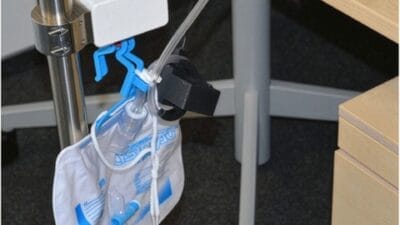
Study at a Glance: Design and Methods
| Design | Prospective feasibility study |
| Population | n = 20 (TURBT n=11, TURP n=9) |
| Duration | ~ 4 hours |
| Sensor technology | In-/Outflow (weight-based), irrigation fluid coloration (optical) |
| Reference | Manual measurements every 20 minutes; BGA selectively |
Key Findings on Digital CBI Monitoring
Im Fokus der Analyse standen vier zentrale Aspekte der digitalen CBI-Überwachung, die für den klinischen Alltag besonders relevant sind. Die Ergebnisse lassen sich in vier Punkte zusammenfassen:
- Volumenmessung (In/Outflow): Die sensorbasierte Erfassung von Ein- und Ausfluss zeigte eine hohe Übereinstimmung mit manuellen Referenzmessungen. Abweichungen lagen im Bereich weniger Milliliter.
- Spüleinfärbung im Verlauf: Veränderungen der Spüleinfärbung wurden kontinuierlich als Verlauf erfasst und entsprachen qualitativ den verfügbaren Werten.
- Flow-Unregelmässigkeiten: Das System erkannte Ereignisse wie Drainage-Unterbrechungen oder Luftblasen, die im bedside-Check klinisch bestätigt wurden.
- Akzeptanz bei Patient:innen: 13 von 20 Patient:innen bevorzugten das sensorbasierte Monitoring gegenüber einer rein visueller Kontrolle.
Relevance for Clinical Practice
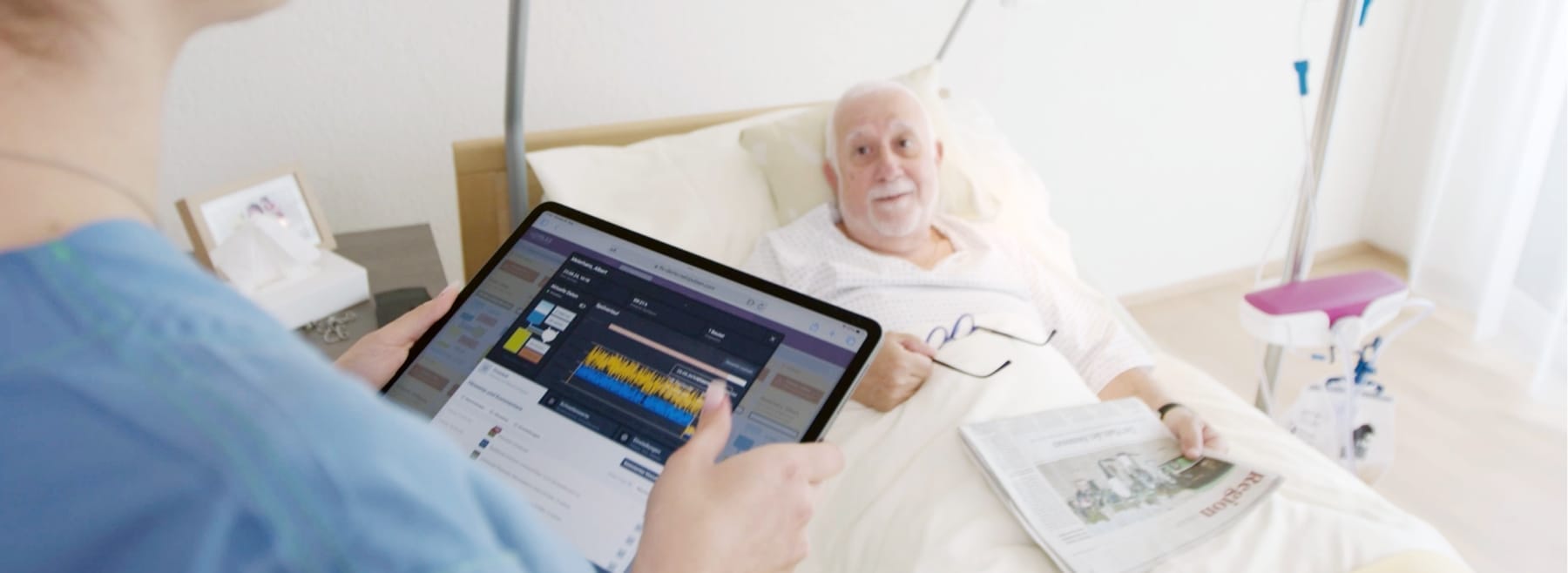
The findings suggest that continuous, objective monitoring of key CBI parameters is technically and organizationally feasible in routine clinical care. Inflow/outflow dynamics and changes in irrigation fluid coloration are visualized in an interpretable manner and can be tracked over several hours.
For clinical practice, this may imply:
- ✓
Objective longitudinal data instead of isolated observations
- ✓
Earlier indication of flow abnormalities possible
- ✓
Improved handovers between shifts
- ✓
A structured data basis for documentation and quality assurance
Authors’ Interpretation: The authors discuss that continuous monitoring of CBI parameters may enable earlier recognition of complications and support clinical decision-making. They further highlight the potential to reduce workload in nursing practice -particularly during night shifts or high-demand periods - and to increase transparency and traceability in documentation processes.
From Study Prototype to Clinical Application: filaxONE
The system evaluated in the study has since been further developed into the next-generation solution and is now available as filaxONE.The clinically evaluated sensor technology forms its technical core and has been complemented by additional features designed for routine clinical operation.
The aim is to transform CBI from a phase that is traditionally difficult to document into a transparent and measurable component of the urological care pathway—providing a structured basis for clinical decisions, nursing workflow organization, and quality management.
--->