
The Importance of Trends Over Time in the Clinical Assessment of Postoperative Bladder Irrigation
In postoperative bladder irrigation, the current clinical picture is only part of the story. What also matters is how the patient’s condition has evolved over the preceding hours.


Following transurethral resection of the prostate or bladder, clinicians are often faced with a practical question: Can continuous bladder irrigation (CBI) be reduced or discontinued, or are there ongoing signs of bleeding activity that may increase the risk of clinically relevant complications?
In clinical practice, this decision depends not only on the appearance of the bladder irrigation at a given point in time, but also on how the situation has evolved over the preceding hours.
Clinical assessment is largely based on point-in-time observations
In routine ward practice, CBI is assessed through repeated clinical checks. Nursing staff monitor catheter drainage, adjust irrigation according to the clinical situation and document relevant changes. The treating physician typically receives this information during ward rounds or through direct communication from the nursing team. The resulting clinical picture is therefore assembled from multiple individual observations, with the current status often taking centre stage:
- Has the patient developed clots?
- Is the catheter draining freely?
- How pronounced is the macroscopic haematuria?
- What level of irrigation is required to maintain adequate drainage?
These observations are essential to clinical care, but they provide only a limited view of how the patient's condition is evolving over time. Changes in irrigation characteristics, temporary drainage problems or increasing bleeding activity may be missed if they are not observed or documented when they occur.
For clinical assessment, the longitudinal trend is key
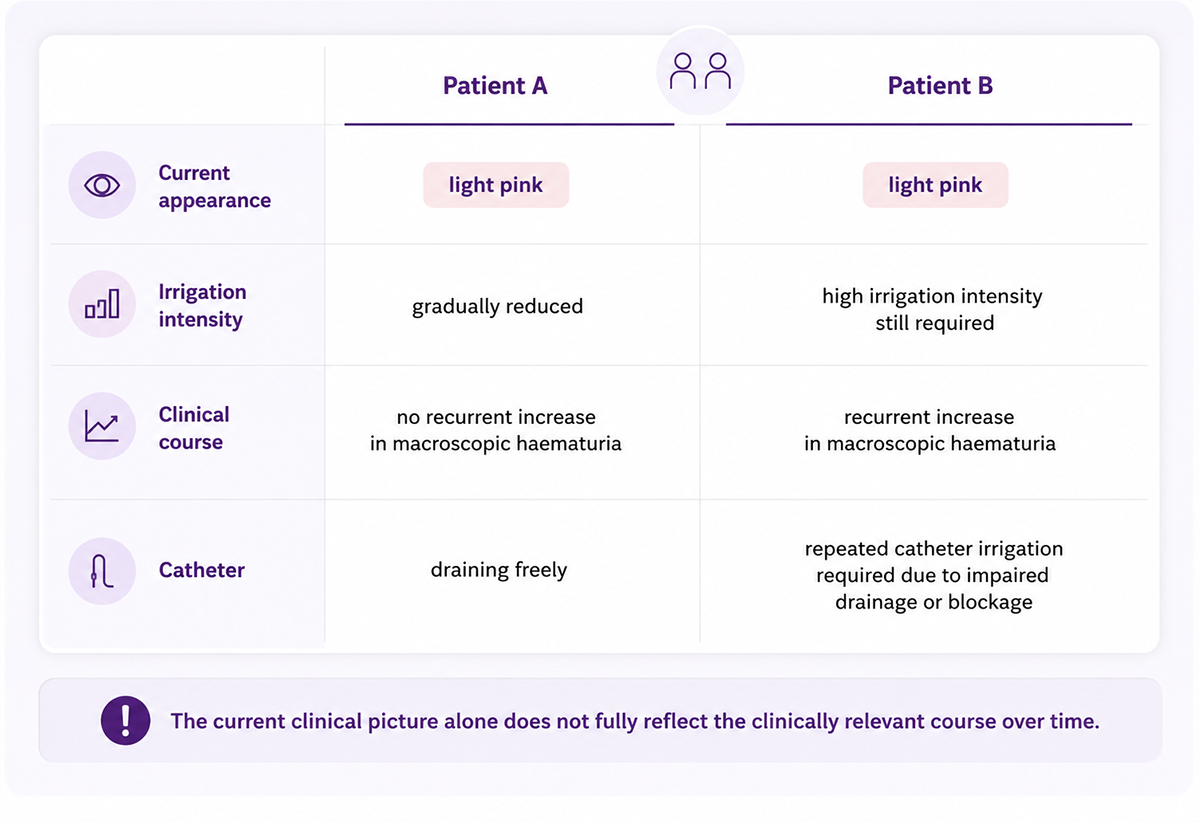
In postoperative bladder irrigation, the trajectory over time can be more informative than any single observation. A patient with consistently mild blood staining presents a different clinical picture from one who develops increasing haematuria, requires progressively more irrigation or experiences recurrent catheter drainage problems over the course of several hours.
The response to reducing irrigation intensity can also provide relevant clinical information. Do the irrigation characteristics and catheter drainage remain stable as irrigation is reduced, or do macroscopic haematuria and clot formation increase again?
Clinical assessment therefore needs to consider not only the patient's current status, but also how that status has evolved over time.
In routine clinical practice, however, this longitudinal information is not always readily available. Assessment depends on the frequency of clinical checks, the quality of documentation and how effectively relevant changes are communicated within the care team.
Structured longitudinal data as an adjunct to clinical assessment
For physicians, changes that emerge over several hours can be particularly relevant. These include the level of irrigation required, the inflow-to-outflow relationship and recurrent impairment of catheter drainage.
A structured view of these trends could help the treating urologist interpret the patient's current status in the context of the preceding clinical course.
Clinical judgement by the treating team remains essential. Whether, and to what extent, structured longitudinal information can improve clinical decision-making requires further clinical evaluation.
Conclusion
Assessment of bladder irrigation following transurethral procedures currently relies primarily on clinical observation. However, clinically relevant interpretation often depends on understanding how the patient's condition has evolved over time.
Digital trend visualisation may help make these changes more structured, accessible and easier to interpret.
Medical disclaimer
The content of this article is intended solely for general information about clinical workflows in urology. It does not constitute medical advice or clinical recommendations. Clinical decisions should always be based on applicable guidelines and the individual situation of the patient.
Author: Filax Medical Editorial Team
The Filax Medical editorial team develops content on clinical workflows, process optimisation and digital solutions in urology. Contributions are based on clinical practice insights, scientific literature and exchange with clinical partners.
Last updated: August 2026
--->